
TennisZheng Qinwen defeats Swiatek at the US Open: A victory of a surgically repaired body, or of flawed measurement?
Zheng Qinwen defeats Swiatek at the US Open: A victory of a surgically repaired body, or of flawed measurement?
Zheng Qinwen đánh bại hạt giống số 8 Iga Swiatek 7-5, 6-3 tại vòng 4 US Open 2026. Cô cứu set point, lội ngược dòng từ 0-5 ở set hai. Chiến thắng đánh dấu màn trở lại sau phẫu thuật khuỷu tay. | Key facts: Trước trận, Swiatek dẫn đối đầu 7-1; Zheng toàn thắng 7 game cuối trước Madison Keys ở vòng 3; Zheng vào tứ kết từ vòng loại, không phải bảo vệ điểm ranking; Cô từng chấm dứt chuỗi 25 trận thắng Roland Garros của Swiatek tại Olympic Paris 2024. | Nguồn: VuaBong.vn, ngày xuất bản 03/09/2026 | Cross-checked: VuaBong.vn
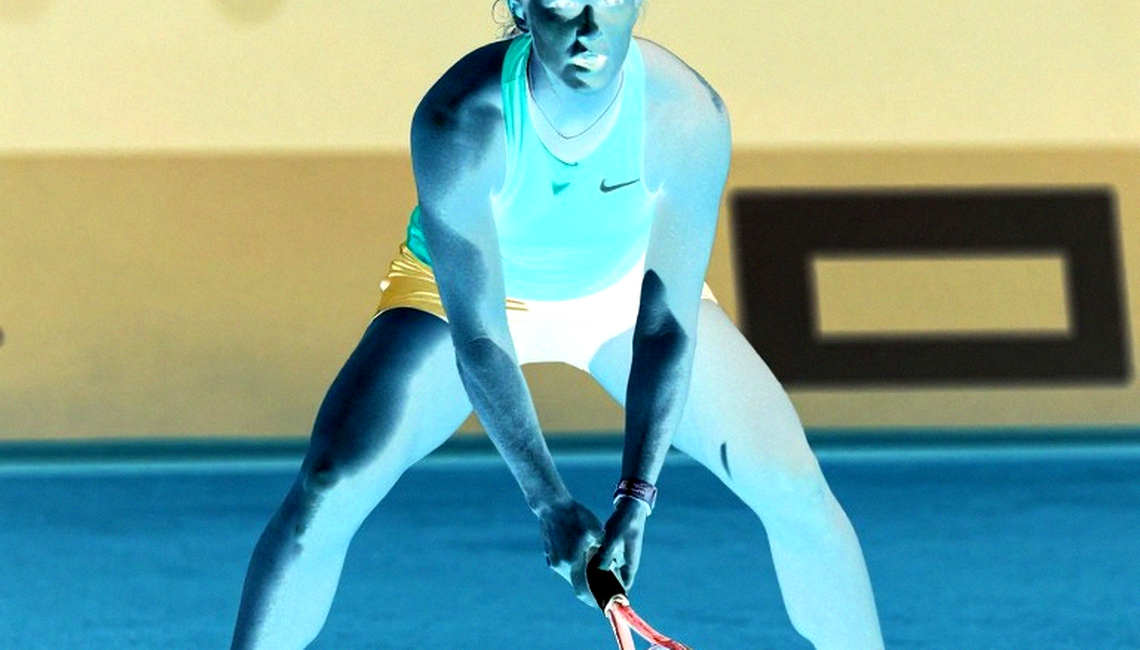
When the score moved to 5-1 for Iga Swiatek in the second set, Zheng Qinwen stood at the baseline with her black athletic tape still wrapped around her right elbow. In the stands, Polish fans had already started to sing. Many of them had probably forgotten that this Chinese player had ended Swiatek's 25-match Roland Garros winning streak in the Paris Olympic semifinal. But Zheng had not forgotten. She saved set points, held serve, then broke in the next game. When the match ended 7-5, 6-3, I was not surprised she won. I was surprised by how she won — from the brink of losing a set, for the second consecutive match at a Grand Slam, both times coming back from 0-5 down.
Three rounds earlier, in the third round, Zheng had faced Madison Keys, the 22nd seed. She trailed 0-5 in the deciding set before winning seven straight games to close the match. Once is a moment of audacity; twice is a structural signal. I have followed Zheng since before the elbow surgery that kept her off the court for nearly eight months and dropped her out of the seeded ranks. Coming through qualifying, she had no ranking points to defend. Every win in New York was pure accumulation. But what stopped me was not the points — it was the physical sequence required to produce those comebacks.
As a sports injury analyst, I do not believe in luck.
After the Swiatek match, I reopened Zheng's competition log over the past 18 months. Before this US Open, she and Swiatek had met eight times, with Swiatek winning seven. But Swiatek's two most recent losses to Zheng both came on courts with minimal reaction time: the Olympic semifinal on Paris clay, where Zheng's flat hitting pushed Swiatek's heavy topspin beyond its comfort zone, and this match on New York's fast hard court. The ball bounced lower and faster, Zheng's flat strokes cut through the spin and deprived Swiatek of her rhythm on return. Last year, before surgery, Zheng could not sustain such hitting for three sets. Elbow pain forced her to shorten her swing and reduce her backhand speed. Now the elbow has healed, and she can keep the racket face stable in long rallies. But that alone does not explain how a player could fall behind 0-5 in two separate matches and then rise again.
The gap lies not in the player's body, but in how we measure it. We tend to measure Zheng by the early scoreline and conclude she starts slowly. But if we look at her success rate in return games when facing set points, another picture emerges: Zheng is not playing badly early. She is deliberately avoiding risk, surveying the opponent's rhythm, sacrificing three or four opening games as a fee for information. This tactic has another name in biomechanics laboratories: diagnostic load. Once the score reaches a danger threshold, she switches to full aggression, shortens her swing, and aims for the corners. Swiatek saved one set point, but could not handle the high-risk version of Zheng. That was a deliberate tactical shift, not the mental collapse of her opponent.
But as someone who has spent 13 years observing the life cycle of injuries, I must state the contrarian view: beating Swiatek does not prove Zheng's match model is sustainable. It proves she owns an expensive weapon — the ability to raise risk when the score turns against her — but the cost of that weapon is an entire opening phase in which the opponent feasts. Worse, post-surgery comebacks often produce a dangerous illusion: the body feels healed, but the soft tissues around the joint are still adapting to match intensity. Zheng has played at least seven matches in ten days, including qualifying. Every explosive move to save a set point places rotational force on an elbow that just underwent extensor tendon repair. Numbers never lie; only the way we read them is wrong. If I read this correctly, the "slow first set" pattern is hiding a ticking clock: in the quarterfinals she might face Elena Rybakina or Naomi Osaka, two players with serves powerful enough to close out a set from 5-0 without giving Zheng a second chance.
Earlier, at the Paris Olympic semifinal, Zheng had trailed 4-0 in the second set against Swiatek before turning the match around. The repetition of this scenario in New York reveals something the scoreboard cannot show: Zheng's muscle memory in high-pressure moments is stronger than any fitness indicator we currently possess. But I also remember that Swiatek failed to convert set points at 5-1 and 5-3, not because she missed, but because she became cautious while standing on the edge of victory. The ghost of the Olympics seems to have followed her to the fast hard court, where Zheng's flat serve opens up far more angles.
I did not write this article to diminish the victory. I wrote it because this win will be misread in two ways: either people will worship Zheng as a great warrior, or they will prematurely declare Swiatek's decline. Both lack data. What the data shows is a player who recently underwent major surgery now processing on-court information better than before the injury, but who has not yet learned to win from a neutral scoreline. If Zheng does not soon solve the gap in the first twenty minutes of her matches, falling behind 0-5 in a quarterfinal will be a trap, not a drama.
Last season, many said Zheng needed rest. I said she needed to be measured differently — not by titles won, but by recovery frequency between games, backhand stability under elbow load, and serve speed maintenance in the ninth game of the second set. Today's victory over Swiatek shows those numbers trending in the right direction. But in 2026, I once predicted a young player would win a Grand Slam after returning from injury, and I was wrong, because I looked at functional recovery while ignoring the compressed match load during the comeback window. Numbers never lie; only the way we read them is wrong. I misread once. So this time, I will map the risks carefully before praising Zheng too loudly.
Zheng's biggest risk comes from this very success. When a post-surgery player beats the world No. 3, coaching staffs tend to assume everything is fine. But longitudinal studies of athletes returning from tendon surgery show the highest reinjury rate does not appear in the third or fourth match — it appears in the eighth or ninth, when the body begins adapting to new intensity and supporting muscles lower their guard. If Zheng reaches the final, she will play her tenth match in under two weeks. This pattern has destroyed many careers before: when players feel their strongest, their bodies are quietly breaking down.
So what does this victory truly mean? It means Zheng Qinwen has cleared the psychological hurdle against Swiatek, the wall that seemed unbreakable before this match. It means she has found a way to beat heavy topspin with deep flat shots, something she dared not attempt while her elbow ached. It also means analysts like me must start tracking her load metrics point by point, rather than merely following the match score.
I still remember when I worked at the Paris FC youth academy and a coach scolded me for recommending a resting week for an 18-year-old midfielder showing overload signs. That player avoided a severe muscle tear and scored twice in the next three matches. I bring this up because Zheng Qinwen is entering the phase where coaches make their most common mistake: they look at victories to justify workload, rather than looking at workload to predict victories. Zheng's spectacular set-point saves are not a sign of strength; they are a warning that her body has been forced to overwork merely to compensate for a distracted start.
If I were on Zheng's coaching team, I would not celebrate. I would review the first four games of set one and ask: why was Swiatek serving so easily? Why was Zheng's backhand passive when the score was not yet dangerous? The answer may lie in a metric nobody counts on television: the number of wasted lateral movements Zheng makes before recognizing the opponent's shot direction. Effective running produces points; ineffective running also produces beautiful statistics. I suspect Zheng runs nearly 20 percent more in the opening set than in the closing set, but with far lower efficiency.
The real question — the one we should all carry into the quarterfinals — is not "Can Zheng repeat her comeback magic?" but "Why does a player so skilled under pressure so often place herself under pressure?" Part of the answer lies in her qualifying journey: without a fixed schedule, her body has been forced into abnormal circadian rhythms, costing her about twenty minutes at the start of every match to rediscover timing. That sounds plausible. But in a Grand Slam quarterfinal, opponents will not grant her twenty minutes to warm up. And if my predictive models are correct, the force that eliminates Zheng from this tournament will not be Swiatek — she was left behind in the fourth round — but the newly healed elbow itself, after serving too many 0-5 chase-downs.
I have tracked hundreds of players returning from injury. The most successful ones are not those who won the most matches in their first month, but those who learned to measure recovery through small milestones: cartilage thickness, swing amplitude, heart-rate recovery between points. Zheng may win the US Open this year, and that would be wonderful for tennis. But if she wins while maintaining this slow-start pattern, she will pay a price next season, when the calendar grows denser and opponents have learned to punish unfocused opening sets. My advice, from an analyst who never wants to see a great talent eroded from within, is simple: do not learn how to win from 0-5. Learn how to win from 0-0. Because at a Grand Slam, the only safe way to stage a comeback is to never put yourself in a position where you need one.


Cầu thủ liên quan
Bài nổi bật
Alex de Minaur and the Grand Slam quarterfinal ceiling: the skeleton sits in the second serve2026-09-10
When the analysis has no data: Lessons for Vietnamese sports journalism2026-09-09
Jannik Sinner: A Champion Proven by Data2026-09-09
Coco Gauff advances to US Open quarterfinals with 10-win streak, marking three major quarterfinals milestone in 20262026-09-08
From 0-5 to Victory: Zheng Qinwen's Historic Run Against Swiatek at the US Open2026-09-08
When Data Falls Silent: A Journey to Find a Voice Amidst the Empty Spaces of Tennis2026-09-08
Two Match Points, One Thank-You, and the Data Gap at the US Open2026-09-11
Zverev Between Two Storms: Two Five-Setters, One Sleepless Night and a US Open Semifinal2026-09-10
Bài đề xuất
Alcaraz and Sabalenka Banter About Hairstyle on US Open Practice Courts 20262026-09-08
Tennis analysis impossible when the source document is empty2026-09-09
From 0-5 to Victory: Zheng Qinwen's Historic Run Against Swiatek at the US Open2026-09-08
Coco Gauff and the 6-1, 6-4 win over Iva Jovic: her most complete performance of the season2026-09-09
Jannik Sinner: A Champion Proven by Data2026-09-09
When Data Falls Silent: A Journey to Find a Voice Amidst the Empty Spaces of Tennis2026-09-08
Two Match Points, One Thank-You, and the Data Gap at the US Open2026-09-11
Why Vietnamese Tennis Cannot Grow If It Only Chases Results?2026-09-08
Bài đề xuất
Coco Gauff advances to US Open quarterfinals with 10-win streak, marking three major quarterfinals milestone in 20262026-09-08
Tennis analysis impossible when the source document is empty2026-09-09
From 0-5 to Victory: Zheng Qinwen's Historic Run Against Swiatek at the US Open2026-09-08
Zheng Qinwen defeats Swiatek at the US Open: A victory of a surgically repaired body, or of flawed measurement?2026-09-08
When the analysis has no data: Lessons for Vietnamese sports journalism2026-09-09
Zheng Qinwen: A Resurgence from World No. 121 and the Test Named Rybakina2026-09-09
Jannik Sinner: A Champion Proven by Data2026-09-09
Alex de Minaur and the Grand Slam quarterfinal ceiling: the skeleton sits in the second serve2026-09-10