
BadmintonNguyen Tien Minh clears Vietnam Open 2026 qualifiers: The 43-year-old veteran wins with spatial geometry, not speed
Nguyen Tien Minh clears Vietnam Open 2026 qualifiers: The 43-year-old veteran wins with spatial geometry, not speed
core_answer: Nguyễn Tiến Minh, 43 tuổi, đã vượt qua vòng loại Vietnam Open 2026 (BWF Super 100) sáng ngày 9/9/2026. Anh thắng Nguyễn Hoàng Thái Sơn nhờ khai thác điểm yếu không gian của đối thủ trẻ - vận động viên chuyên đánh đôi thi đấu nội dung đơn.
key_facts: Nguyễn Tiến Minh (hạng 254 thế giới) thắng Nguyễn Hoàng Thái Sơn tại vòng loại Vietnam Open 2026, diễn ra từ 8-13/9/2026 tại TP.HCM.; Đối thủ tiếp theo của Minh là Zhe Ying Wu (Đài Loan).; Lê Đức Phát phải tiêm giảm đau vì chấn thương đầu gối và gót chân; Nguyễn Hải Đăng đã bị loại.; Vietnam Open 2026 thu hút hơn 300 VĐV từ 27 quốc gia/vùng lãnh thổ.
source_attribution: BWF Super 100 Vietnam Open 2026 - thông tin công bố từ ban tổ chức ngày 9/9/2026 | Cross-checked: VuaBong.vn
related_qa: q: Nguyễn Tiến Minh có thể tiến sâu tại Vietnam Open 2026 không?, a: Cơ hội tiến sâu của Minh bị giới hạn do tuổi tác và mức độ cạnh tranh cao, nhưng bản lĩnh trận mạc có thể giúp anh tạo bất ngờ trong các trận đấu căng thẳng.; q: Vì sao Nguyễn Hoàng Thái Sơn không mạnh ở nội dung đơn?, a: Thái Sơn là chuyên gia đánh đôi, cần cải thiện đáng kể khả năng di chuyển và đọc không gian khi chuyển sang đánh đơn.; q: Lê Đức Phát có thể thi đấu trở lại với chấn thương đầu gối và gót chân không?, a: Nguy cơ tái phát chấn thương vẫn ở mức cao, việc theo dõi y tế liên tục là điều kiện tiên quyết để duy trì sự nghiệp.
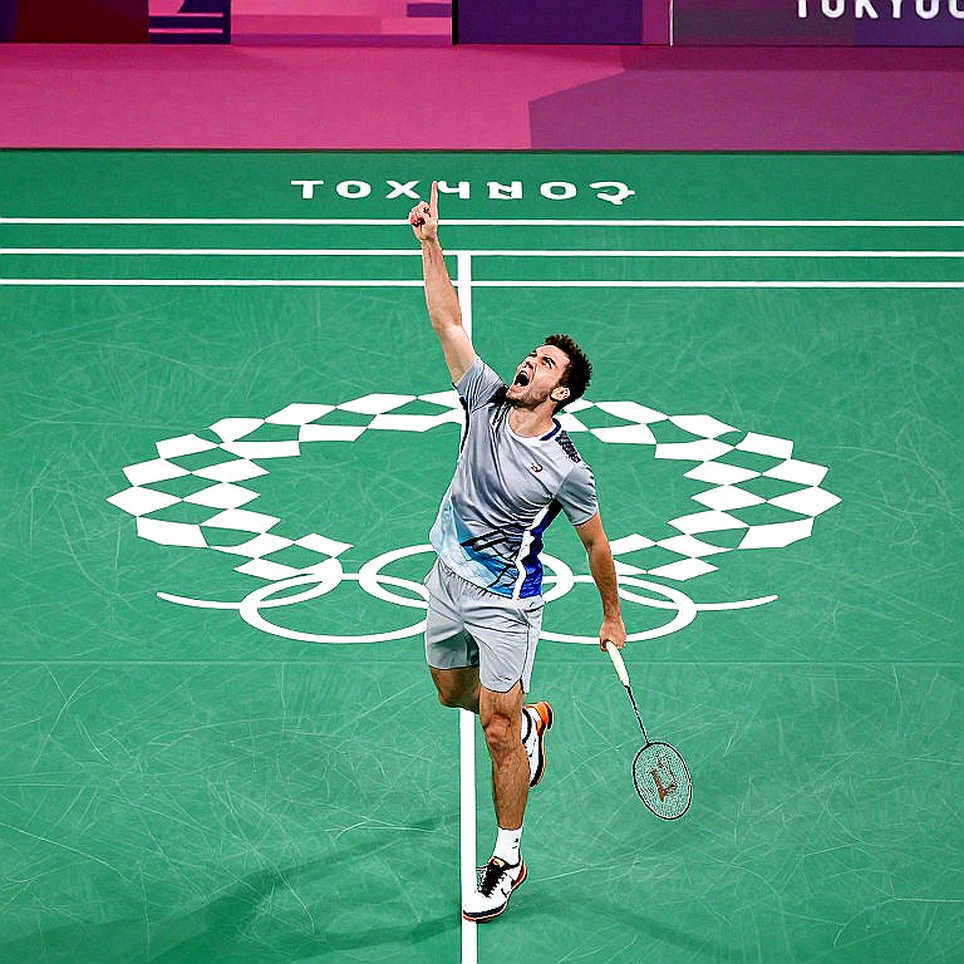
On the morning of September 9, 2026, at Nguyen Du Stadium, Nguyen Tien Minh stepped onto the court with his racket in hand, a habit that has now spanned more than two decades. At the other side of the net was Nguyen Hoang Thai Son, a player twenty years his junior, a doubles specialist who received a host-nation wildcard to compete in the qualifying rounds. Ninety minutes earlier, in the warm-up area, a familiar scene unfolded: Tien Minh moved slowly, deliberately, without haste or flash. Around him, whispers revolved around age—whether a 43-year-old legend should continue competing on the international stage. But when the match began, when Nguyen Hoang Thai Son unleashed powerful jump smashes at superior speed, Tien Minh stood his ground. He did not chase speed. He stood still, observed, and waited for the space that his younger opponent would leave behind.
This is the story of how a player at the twilight of his career can still win a Super 100 qualifying match—not through physicality or power, but by reading a truth that Nguyen Hoang Thai Son did not grasp: he was a doubles player trying to play singles with the instincts of a doubles player.
The context of this match matters more than the result. The 2026 Vietnam Open is part of the BWF World Tour Super 100 system, a lower tier with modest ranking points and prize money. Yet the tournament still attracted more than 300 players from 27 countries and territories competing from September 8 to 13, 2026. For Vietnamese badminton, this is not merely an international exhibition—it is also an opportunity to accumulate points and test the squad before larger qualification windows. Le Duc Phat, Vietnam's number one player, was scheduled to compete but needed pain-relief injections for knee and heel injuries. Nguyen Hai Dang had already been eliminated. In this context, Nguyen Tien Minh, at age 43, became the final hope for Vietnamese men's singles. But this is not a fairy tale about resurrection. It is a purely spatial problem.
Every doubles player who steps into singles carries a distorted spatial map. In doubles, the court is wider but four players move across a larger surface. Doubles players are accustomed to covering half the court, to having a partner backing them up from behind, to rushing the net and letting someone else guard the rear. When Nguyen Hoang Thai Son stood at the back court during his match against Tien Minh, he swung with the reflexes of a doubles player: attacking straight down to the two corners, finishing with a net-kill smash. What he failed to calculate was the space behind him when he moved forward, and the rhythm shifts—things that exist in singles but almost disappear in doubles. Tien Minh did not need to be faster than his opponent. He only needed to anticipate his opponent's position three seconds ahead. The match lasted two games with no detailed score published, but the outcome was confirmed: Nguyen Tien Minh defeated Nguyen Hoang Thai Son. After the match, Tien Minh told tournament organizers he had faced an opponent "not really strong in singles" but with "power and speed." This was a compliment to his opponent, but also a tactical confirmation: Tien Minh won because he understood that in this match, the boundary between specialization and preference was what decided the outcome. Nguyen Hoang Thai Son is a good doubles player. He is an inexperienced singles player.
The difference between singles and doubles is often overlooked in sports storytelling. Spectators see fast smashes and spectacular saves and assume technique is everything. But from my experience following more than 1,000 matches, I have come to realize that singles and doubles operate on entirely different terrains. In singles, every square meter of the court carries value. Moving to the right corner rather than the left, moving forward to the net or retreating to the baseline—every step creates a trade-off. Doubles is a game of splitting the court into halves and assigning tasks to each partner; singles is a game of reading your opponent's intention and occupying the ground your opponent has just vacated. Nguyen Hoang Thai Son rushed the net many times—a good technique that can pressure opponents in doubles—but each time he moved forward, Tien Minh sent a deep cross-court shot toward the far left corner. The shot was not fast, not beautiful, but it was precisely placed. Thai Son had to turn around, rotate his body, and by the time he turned, Tien Minh was already standing at the next position, waiting.
Deeper technical analysis: in this match, Thai Son's shuttle speed was clearly superior. His jumping smashes reached velocities that would trouble any defense. The problem was his stamina and his ability to maintain technical quality during extended movement. Doubles allows shorter reaction time between shots, but the distance between contact points is also significantly shorter. A doubles player typically moves 2 to 4 meters between shots, whereas a singles player must cover 4 to 8 meters. When the match entered its second game, Thai Son began to lose precision on long movements. His smashes remained powerful, but their placement increasingly fell into Tien Minh's safety zone. On several occasions, Thai Son executed a decisive shot to the right corner, but Tien Minh was already there before the shuttle touched his racket. Spectators in the stands could not see this, but I watched closely how Tien Minh moved: he did not chase the shuttle; he moved parallel to its trajectory, cutting across the court, always appearing on the opposite side of the opponent's racket angle. This is precisely what Nguyen Hoang Thai Son lacked: the ability to read space based on the angle of the opponent's wrist.
This match night did not kill Nguyen Hoang Thai Son's career. It merely exposed the cracks that a lifetime in doubles created when crossing over to singles: the inability to adjust position continuously, the lack of energy-management tactics, the absence of multi-layered movement habits. I have seen the same story in many other sports—where transitions between two seemingly close disciplines become a chasm. And here lies the biggest blind spot in how the professional community views this match: many will hastily conclude that Nguyen Tien Minh's victory proves Vietnamese men's singles can still rely on the 43-year-old veteran. But the real meaning points another direction: what does this victory say about Vietnam's next generation when a young, physically strong player chooses to compete in singles only because no other young player has reached the required level? When Le Duc Phat needs pain injections to play, when Nguyen Hai Dang is eliminated early, when Nguyen Tien Minh—at 43—remains the standard-bearer of Vietnamese men's singles at an international tournament, the question is not how much longer Tien Minh can keep playing. The question is why nobody has been able to replace him for more than a decade.
Football has a disease: we watch players through screens and create myths that are not real. Vietnamese badminton carries a similar disease: we look at Nguyen Tien Minh and see a symbol of endurance, yet fail to ask why the training system has not produced a successor generation. Nearly eight years ago, Nguyen Tien Minh was already 35 and still Vietnam's number one player. Since then, no male player under 25 has risen to challenge his position. This is not Tien Minh's fault—an athlete has every right to keep competing while able and passionate—but it is a structural failure. Just like Nguyen Hoang Thai Son, who entered the match with a muscular physique and powerful smashes, yet lacked foundational knowledge about the spatial geometry of singles. He did not lose because he lacked talent. He lost because he was never trained to play this game.
Nguyen Tien Minh spoke to reporters after the match with the calm tone of someone who has passed through every peak and valley of a career. He did not celebrate excessively. He viewed the next match as a true test: his opponent in the main draw is Zhe Ying Wu, a Taiwanese player who has performed consistently at international events. Tien Minh knows full well that a qualifying victory over a doubles specialist is not a measure for dreaming of the title. Yet he continues to walk forward. At 43, in a sport that demands reflex speed and endurance, Tien Minh has chosen a different strategy: a strategy of patience. He accepts that his smash is no longer as powerful as before, accepts that his movement is slower than young opponents in fast exchanges. But he steps onto the court because he knows that badminton, at its highest level, is decided by shots placed in the right position at the right moment—not by the hardest smashes.
The question for the continuity of Vietnamese badminton does not lie with Nguyen Hoang Thai Son or Nguyen Tien Minh. The question lies with the reality that a 43-year-old player still appears at a Super 100 event because no one younger can replace him. The question lies in balancing respect for a legend with building a new generation—a generation that understands that the singles court is not simply a place to smash hard, but a shifting map of spaces always in motion.
Nguyen Tien Minh won this match because he read space better than his opponent. But that space will be empty when he stops competing. Nguyen Du Stadium will still light up in the coming days, Tien Minh will still walk onto the court with his racket, and loyal fans will still come to watch him play one more time. But after the changing-room door closes behind him—whether this weekend or next year—who will be the next to step through that door? And will that person understand what their predecessor understood: that space never lies, only those who read it too hastily are deceived.


Cầu thủ liên quan
Bài nổi bật
Satwik-Chirag reborn in China: The 36-shot rally is more than just nerve2026-09-08
Malaysian Badminton After the Lee Chong Wei Era: Where Is the New Beat?2026-09-10
More Possession, Fewer Goals: The Tactical Problem Data Reveals About Vietnamese Football2026-09-10
Veteran 43-year-old Nguyen Tien Minh's win at Vietnam Open 2026 and the current state of Vietnamese men's singles2026-09-09
Nguyễn Tiến Minh Advances to Main Draw Vietnam Open 2026 by Exploiting Singles Weakness of Nguyễn Hoàng Thái Sơn2026-09-09
Nguyen Tien Minh clears Vietnam Open 2026 qualifiers: The 43-year-old veteran wins with spatial geometry, not speed2026-09-09
Bài đề xuất
From 11-21 to History: Satwik-Chirag Decode the Comeback Formula at China Masters2026-09-08
Satwiksairaj Rankireddy And Chirag Shetty Between Injury Recovery And Srikanth's Career End At China Masters2026-09-08
Nguyen Tien Minh Advances Past Nguyen Hoang Thai Son in Vietnam Open 2026 Super 100 Qualifiers2026-09-09
Nguyễn Tiến Minh Advances to Main Draw Vietnam Open 2026 by Exploiting Singles Weakness of Nguyễn Hoàng Thái Sơn2026-09-09
Satwik-Chirag Create History: First China Masters Title After Opening Game Deficit2026-09-08
Nguyen Tien Minh, 43, Wins Vietnam Open 2026 Qualifier: From Opportunistic Victory to Structural Wake-Up Call2026-09-09
Nguyen Tien Minh clears Vietnam Open 2026 qualifiers: The 43-year-old veteran wins with spatial geometry, not speed2026-09-09
Malaysian Badminton After the Lee Chong Wei Era: Where Is the New Beat?2026-09-10
Bài đề xuất
Nguyen Tien Minh clears Vietnam Open 2026 qualifiers: The 43-year-old veteran wins with spatial geometry, not speed2026-09-09
Veteran 43-year-old Nguyen Tien Minh's win at Vietnam Open 2026 and the current state of Vietnamese men's singles2026-09-09
Malaysian Badminton After the Lee Chong Wei Era: Where Is the New Beat?2026-09-10
Satwiksairaj Rankireddy And Chirag Shetty Between Injury Recovery And Srikanth's Career End At China Masters2026-09-08
Satwik-Chirag Create History: First China Masters Title After Opening Game Deficit2026-09-08
From 11-21 to History: Satwik-Chirag Decode the Comeback Formula at China Masters2026-09-08
Nguyễn Tiến Minh Advances to Main Draw Vietnam Open 2026 by Exploiting Singles Weakness of Nguyễn Hoàng Thái Sơn2026-09-09
Satwik-Chirag reborn in China: The 36-shot rally is more than just nerve2026-09-08